

Optical sections of EdU-labelled Medicago truncatula root nodule primordia 7-days post inoculation imaged under a confocal microscope. Images by Ella Greensmith.
Breakthrough protocol gives scientists pinpoint control over root nodule development
Dr Katharina Schiessl’sresearch group has developed a powerful new protocol that allows scientists to trigger and visualise the earliest stages of symbiotic root nodule formation with unprecedented precision in the model legume Medicago truncatula.
The method published in STAR Protocols, developed by Dr Schiessl and lab members Georgina Wickens and Ella Greensmith, combines highly controlled rhizobial spot inoculation with advanced deep-tissue imaging, enabling researchers to determine exactly where and when nodules form along the root.
This level of spatiotemporal precision opens the door to detailed analysis of cell proliferation and cell expansion during the earliest phases of nodule organ development.
Precision nodulation, high synchrony
Symbiotic root nodules form when soil bacteria known as rhizobia infect plant roots and establish a nitrogen-fixing partnership. Studying the earliest cellular events of this process has traditionally been challenging because nodules can emerge at variable positions and times along the root.
The new protocol overcomes this limitation. By marking a defined root zone and applying a precise droplet of rhizobia, researchers can induce highly predictable nodulation events.
In successful experiments, at least 75% of nodules form close to the marked inoculation site within seven days in A17/Jemalong and R108 wild-type backgrounds. In optimal conditions, efficiency can reach 100% in A17/Jemalong seedlings.
This reproducibility allows scientists to harvest homogeneous root tissue enriched for early nodulation processes — ideal for downstream genomics, biochemistry and cell biology analyses.
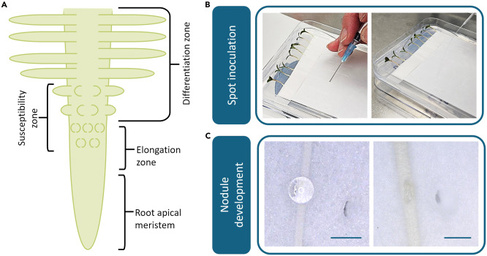
Rhizobial spot inoculation of Medicago truncatula seedlings with Sinorhizobium meliloti. (A) Schematic of Medicago root tip with zones. (B) Spot inoculation. We mark the susceptibility zone and apply a droplet of bacterial suspension to the root close to the marked spot. Scale bar = 1 mm. (C) Nodule development. A nodule will emerge at the site of droplet application 7 days post inoculation. Scale bar = 1 mm.
Deep imaging without genetic reporters
A major innovation of the protocol is its deep-tissue imaging approach, which does not require genetically encoded fluorescent reporter lines.
The team adapted an EdU/Alexa Fluor 488-azide DNA labelling strategy, which was originally developed for studying cell cycle activity in the shoot apical meristems of Arabidopsis thaliana, to visualise DNA replication and cell geometry in developing nodules.
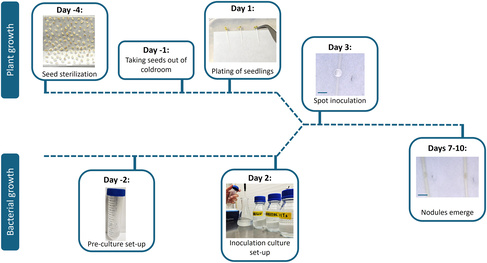
The workflow includes:
- Preparation of rhizobia and seedlings for spot inoculation
- Root zone marking and precise bacterial droplet application
- Incubation in EdU medium to label DNA replication
- Sample fixation and replicated DNA labelling
- Tissue clearing and cell wall staining
- High-resolution confocal imaging
This enables direct mapping of cell proliferation and expansion behaviour in developing nodules and other root tissues without the time and technical barriers associated with generating transgenic reporter lines.
Broad applicability beyond model species
Because the imaging does not rely on fluorescent reporters, the protocol is readily adaptable to other legume and non-legume species that are difficult to transform genetically or where introgressing reporter lines through crossing is impractical.
By integrating reproducible nodule induction with deep-tissue imaging of cell cycle activity and cell geometry, the method provides a robust platform for cutting-edge approaches such as single-cell and spatial transcriptomics of early nodule development.
A practical resource for the field
In addition to the core methodology, the protocol includes extensive troubleshooting guidance, making it accessible and reproducible for laboratories adopting the technique.
Together, the approach provides vital new insights into the cellular and molecular mechanisms underpinning early symbiotic organ formation and equips researchers with a fast, efficient and adaptable tool for exploring how plants build nitrogen-fixing nodules.
Reference
Georgina Wickens, Ella Greensmith, Katharina Schiessl (2026) Spatiotemporal analysis of cell division during symbiotic root nodule development in the model legume Medicago truncatula. STAR Protocols, Volume 7, Issue 1. DOI: 10.1016/j.xpro.2026.104371