

Maritime history charity teams up with Cambridge scientists to tackle rapid wood decay
A North Norfolk–based maritime charity has turned to scanning electron microscopy (SEM) in a race to save some of the region’s most iconic traditional boats.
Robin and Linda West, Secretary and Trustee of the charity Rescue Wooden Boats, visited the Sainsbury Laboratory this week to examine larch timber from historic Norfolk crab boats using a scanning electron microscope. The imaging was carried out by Sainsbury Lab visiting researcher Trevor Groves, who analysed the wood at a microscopic level and used x-ray analysis to reveal the elemental composition of the timber to better understand why these boats are deteriorating at an accelerating rate.
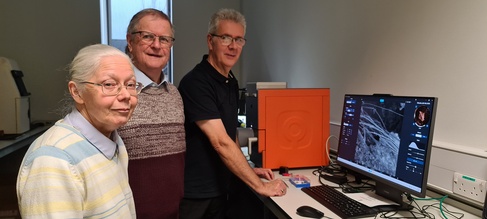
Rescue Wooden Boats works to preserve the last surviving timber crab boats built between the mid-1920s and 1970s. Traditionally clinker-built with larch hulls and oak timbers (ribs), these vessels were once part of a large fishing fleet serving coastal communities along the Norfolk coast. While no longer used for commercial crab and lobster fishing, around 25 boats remain afloat today, used recreationally from spring to autumn – many still owned by the same families for generations.
“These boats are unique to the North Norfolk coast,” said Robin West. “They’re instantly recognisable and part of the identity of places like Cromer, Sheringham, Wells-next-the-Sea and Brancaster Staithe. Losing them would mean losing a living piece of maritime heritage.”
Rotting from the inside out
The charity’s growing concern is that some boats are now rotting far more quickly than in previous decades. While seawater might seem the obvious culprit, the research points elsewhere.
“Surprisingly, it isn’t the seawater that’s doing the damage,” Robin explained. “It’s rainwater collecting inside the boats. The hulls are rotting from the inside out.”
Robin believes climate change is playing a major role, with warmer temperatures and increased rainfall creating ideal conditions for fungal decay. Another factor may lie in the timber itself.
“The original boats were built using slow-grown, locally sourced timber from wild forests,” he said. “Over the years, replacement wood has often come from managed European forests where trees grow faster. Faster growth usually means lower density wood, and we suspect that makes it more vulnerable to decay.”
Peering inside the wood
To investigate, Robin and Linda brought three samples to the laboratory: two pieces of severely rotted larch and one unused piece of new timber. Under the scanning electron microscope, the samples revealed fungal spores, networks of hyphae, and varying degrees of structural breakdown.
“What we could see was fascinating and worrying at the same time,” said Linda West. “Some of the timber structure had clearly been destroyed, while other components—like the tracheids, seemed more resistant. That gives us clues about what the fungi are targeting and what still offers strength.”
Tracheids are elongated xylem cells with thick, lignin-reinforced walls, and their survival suggests potential pathways for targeted preservation.
A scientific race against time
Both Robin and Linda bring scientific backgrounds to the challenge, with experience in physics and chemistry. In the past when they ran a business, they developed their own treatments for protecting garden timber furniture. Now, they are applying the same problem-solving mindset to heritage boats.
“We’re in a race against time,” Linda said. “Our goal is to find treatments that genuinely protect the timber but are also environmentally responsible. These boats sit in sensitive coastal waters, so anything we use must not contaminate the sea.”
The charity is also exploring alternative maintenance approaches, including whether occasional seawater exposure – leaving protective salt residues as it evaporates – might help slow decay.
Keeping heritage afloat
Rescue Wooden Boats operates a Maritime Heritage Centreat Stiffkey, near Wells-next-the-Sea, open on Sundays from April to October, where visitors can learn more about the boats and the charity’s conservation work.
“These boats aren’t museum pieces, they’re still alive, still afloat,” Robin said. “With the right science and care, we believe they can remain part of Norfolk’s coastline for generations to come.”
More information about the charity and its work can be found at www.rescuewoodenboats.com