

Confocal scanning laser microscopy and fluorescence lifetime imaging microscopy, together with Raman analyses, allowed researchers to resolve different features of the plant and fungal structures in the Windyfield chert fossil of the early land plant Aglaophyton majus. Images by Raymond Wightman, taken on SLCU's SP8-FLIMan confocal.
An ancient plant-fungus relationship has been revealed using advanced microscopy imaging, providing evidence of the mutually beneficial relationship that enabled plants to adapt to life on land.
Researchers from the University of Cambridge and Natural History Museum have identified a new species of ancient symbiotic fungus preserved within a 407-million-year-old plant fossil from Scotland. The discovery provides unprecedented three-dimensional insight into one of the earliest known plant–fungus partnerships, known as mycorrhiza.
Gardeners and farmers know mycorrhizae are vital for plant health with these fungi living symbiotically inside plant roots, extending their reach to absorb water and nutrients like phosphorus. This mutually beneficial partnership underpins the majority of plant life today and is one of nature’s most successful relationships.
Studying this partnership, which dates back to when plants first colonised land, is revealing new information about how plant-fungi partnerships shaped ecosystems for hundreds of millions of years.
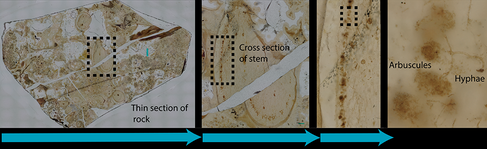
The original thin polished sample of Windyfield chert (left) was placed on a slide and imaged under a Keyence microscope. Zooming in on the sample revealed exquisitely preserved fungal structures, including details of hyphae and arbuscules. Images by Gareth Evans taken using SLCU'sw Keyence brightfield microscope.
Beyond this new fossil fungi species discovery, the advanced microscopy techniques used to distinguish the fungus from the surrounding plant cells open a powerful new way to identify fossilised life forms. By analysing their unique light signatures — a kind of natural fingerprint preserved through time — scientists can detect traces of organisms long after their DNA has vanished.
Published in New Phytologist, the paper describes a new species of arbuscular mycorrhizal fungus, Rugososporomyces lavoisierae, forming a symbiotic relationship with the early land plant, Aglaophyton majus — the second fungal species known to have been hosted by this plant.
The fossil from the Windyfield Chert, Scotland provides the most detailed evidence to date that early land plants engaged in complex symbiotic relationships with multiple fungal species over 400 million years ago.
The implications of this discovery extend far beyond the immediate findings.
“This is just the start,” said Professor Sebastian Schornack, Group Leader at the Sainsbury Laboratory Cambridge University, who co-led the study. “By applying these methods to the fossilised remains of different organisms, we now have a powerful new tool to tell apart structures that may look similar but differ in their fine ultrastructure, for example ancient arthropods, plants and fungi.”
“This technique adds a new dimension to how we identify, describe and discriminate fossilised ancient life, using the unique light signals these materials emit as a kind of fingerprint. Although the original biological material is fossilised and no DNA remains, these optical signatures preserve vital clues to their identity.”
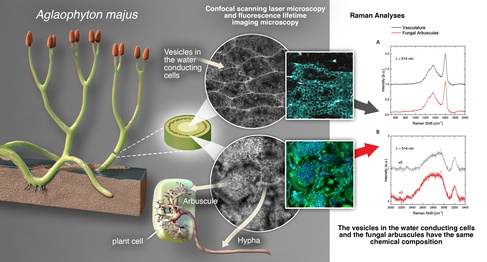
Confocal scanning laser microscopy and fluorescence lifetime imaging microscopy, together with Raman analyses, allowed us to resolve different features of the plant and fungal structures in the fossil of the early land plant Aglaophyton majus. Copyright: Victor O. Leshyk. Provided by the Natural History Museum.
Using these techniques with other fossils from the Windfield and nearby Rhynie cherts, researchers aim to understand how early symbioses evolved and how plants and fungi first learned to coexist.
The fossil analysis brought together specialists from the Natural History Museum who found the new fungus and conducted brightfield microscopy and confocal microscopy with the Muséum d’Histoire Naturelle in Paris; the Sainsbury Laboratory Microscopy Core Facility, who conducted confocal, fluorescence lifetime imaging microscopy (FLIM) and Raman imaging; and the Cambridge Graphene Centre, responsible for Raman spectroscopy.
The combined use of advanced imaging and spectroscopy applied for the first time to a fossil plant enabled the team to distinguish fossilised fungal and plant tissues based on their unique light signatures, marking a breakthrough that could transform how scientists’ study ancient life in the future.
“By combining confocal fluorescence lifetime imaging with Raman spectroscopy, we can chemically identify ancient microscopic life forms with remarkable precision. Our new technique is opening an exciting new window on life’s earliest chapters,” said Dr Raymond Wightman, Manager of the Sainsbury Laboratory Microscopy Core Facility who led the FLIM imaging work.
The fossil, held at the National Museum of Scotland, Edinburgh, was prepared and studied by the Natural History Museum’s scientific associateDr Christine Strullu-Derrien, who co-led the study.
This fossilised relationship was found to closely resemble modern arbuscular mycorrhizal associations that continue to play a vital role in plant nutrition and soil health today.
“Mycorrhizas are very rare in the fossil record and have never been found in the Windyfield Chert before,” said Dr Christine Strullu-Derrien. “The presence of the arbuscule shows that the fungus wasn’t parasitising on the plant or feeding on it after death – instead, there was a symbiotic association. The fungus would have provided minerals like phosphorus in return for sugars from the plant in a way that benefits them both.”
Dr Paul Kenrick, a fossil plant expert at the Museum, and co-author of the study, added: “It’s extraordinary to find such ancient evidence of a symbiotic relationship. It appears that symbioses were a necessary part of allowing plants to adapt to life on land; this symbiosis resembles that observed in modern liverworts or hornworts; these plants like the early land plants don’t have roots. Finding out more about how these relationships developed can contribute to our knowledge of the past, present and future.”
Reference
Christine Strullu-Derrien, Raymond Wightman, Liam McDonnell, Gareth Evans, Frédéric Fercoq, Paul Kenrick, Andrea Ferrari and Sebastian Schornack (2025) An arbuscular mycorrhiza from the 407-million-year-old Windyfield chert identified through advanced fluorescence and Raman imaging. New Phytologist.
DOI: https://doi.org/10.1111/nph.70655
Naming of Rugososporomyces lavoisierae
Rugososporomyces lavoisierae is named in honour of Marie-Anne Pierrette Paulze Lavoisier (1758-1836) whose contributions were pivotal to the development and standardisation of the scientific method. Fluent in English and French, she translated and critically analysed key scientific texts of her time, including Richard Kirwan’s ‘Essay on Phlogiston’. Her work allowed Antoine Lavoisier (her husband) and others to dispute Kirwan’s long-standing theory that all combustible materials contained a fire-like element called phlogiston. Through experiments carried out by her husband, in which she actively participated, they demonstrated that combustion involves oxygen. She also contributed to research on the chemistry of human respiration, and her scientific illustrations played a critical role in the development and communication of modern chemistry in the 18th century.
About the Natural History Museum
The Natural History Museum is a world-leading scientific research centre and one of the world’s most visited museums. Our mission is to create advocates for the planet – people who act for nature. Our 400 scientists are finding solutions to the planetary emergency - from reversing biodiversity loss to resourcing the green economy. We are seeking an additional £150 million to transform our South Kensington building: placing our groundbreaking research at its heart, revitalising four existing galleries, opening two new magnificent galleries and delighting 1 million more visitors a year with the wonders of the natural world.
About the Sainsbury Laboratory
The Sainsbury Laboratory Cambridge University (SLCU) is dedicated to advancing plant science through cutting-edge research that explores the genetic, molecular, and ecological processes that shape plant life. Located within the Cambridge University Botanic Garden, our state-of-the-art research facility opened in 2011 and was made possible through a generous donation and ongoing core funding from The Gatsby Charitable Foundation. We adopt a multidisciplinary approach to investigate the highly plastic and robust regulatory systems underlying plant growth and development, examining them at scales from the molecular level to ecosystem level, using cutting-edge techniques and technologies. We bring together specialists in biological, physical, and mathematical sciences. This interdisciplinary approach is essential for understanding the complex dynamic and self-organising properties of plants. Quantitative plant science enables us to explore and deepen our fundamental understanding of how plants function.
About the Cambridge Graphene Centre
The Cambridge Graphene Centre (CGC) advances the science and technology of graphene, carbon allotropes, layered crystals, and hybrid nanomaterials. Its mission is to translate pioneering research into real-world applications through close collaboration between academia and industry. The Centre’s state-of-the-art facilities bridge the gap between laboratory discovery and scalable production, enabling the development of printed and flexible electronic devices, energy storage technologies, and smart, connected systems. Research at the CGC is organised around four themes—materials growth and printing, energy, connectivity, and detectors — all aimed at creating energy-efficient, flexible, and multifunctional technologies. The Centre’s work is supported by the Engineering and Physical Sciences Research Council (EPSRC), the Graphene and Quantum Flagships, and the European Research Council.
About New Phytologist
New Phytologist is a leading international journal focusing on high quality, original research across the broad spectrum of plant sciences, from intracellular processes through to global environmental change. The journal is owned by the New Phytologist Foundation, a not-for-profit organisation dedicated to the promotion of plant science.
Website: https://www.newphytologist.org/